
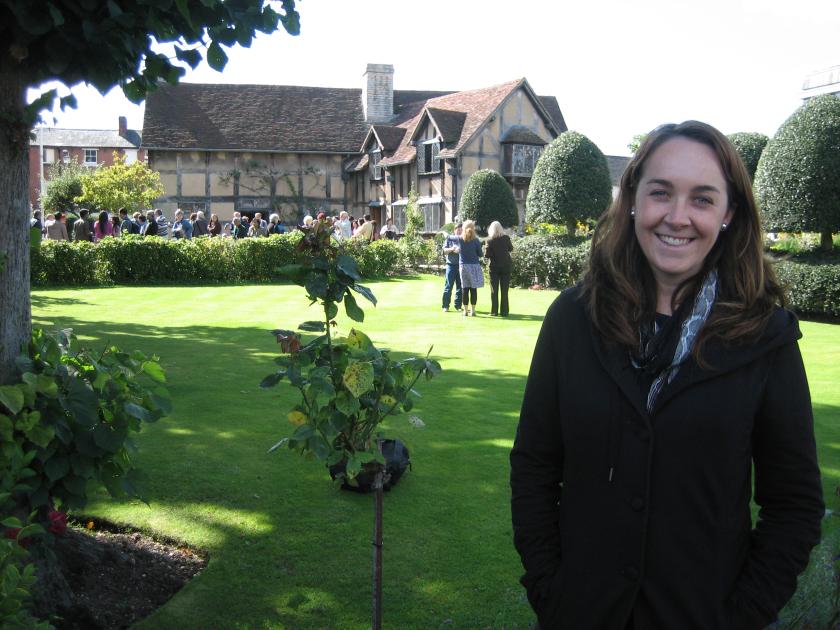
As some of you may know, my term as CODE President concluded with the beginning of my four-over-five sabbatical and a move to England to begin postgraduate studies. Over the past five months, I’ve become immersed in the world of drama education, both in theory (through my reading and university studies) and in practice (through school visits and volunteer teaching). This entry is the first in what will be a series of posts highlighting issues, trends and helpful information from ‘across the pond’. As the unofficial ‘CODE Ambassador’ to the UK, I hope to promote the fine work we are doing in Ontario and bring professional knowledge to my friends and colleagues in the CODE network. I’m also happy to answer your queries about topics of interest to you, so feel free to add your comments to this post and I’ll be sure to follow up in the future!
So, now for some background on my adventure. The program in which I am currently enrolled is the Masters of Drama and Theatre Education at the University of Warwick in Coventry, England. The program is one of the few drama education-focused postgraduate programs in the world—an odd fact I discovered when researching schools last year. Why does Ontario not have such a program for teachers? you might be asking. I’ve been asking myself the same question! With the wealth of world-renowned expertise we have both at the faculties of education and in schools, it seems like a long-overdue development, and one that I hope will soon be rectified so that more of us can continue our education and professional development at home.
The MA program at Warwick is led by professors Dr. Joe Winston and Professor Jonothan Neelands, with support from lecturers and guest instructors. Jonothan is well-known to us at CODE, as he has visited Canada on numerous occasions, conducting workshops and presenting at CODE conferences. The program has a strong focus on issues of progressive education and democracy, as well as aesthetic and social concerns important to drama and theatre education. My studies last term varied from the role of story in drama (which culminated in a storytelling theatre performance of a fairy tale, my first performance in many years!) to the study of major theorists and practitioners in drama and theatre. I’ve read an amazing amount of scholarly material, which has expanded my ideas about education and challenged my assumptions of my own teaching. I hope to share some of these resources with you in future posts.
Perhaps the most valuable aspect of the MA course at Warwick is its international character. Students come from all over the world to study, and it is by working together and sharing our cultures that we truly learn about education. Believe it or not, but I am the only North American student in my course! My classmates come from countries as diverse as China, Ireland, Greece, Taiwan, Cypress, Britain, South Korea, Singapore and Malaysia. Many are teachers, some theatre practitioners, and some are interested in drama education because their own education systems have so little of it. This fact has been an eye-opening development for me. In Ontario, we often bemoan the place of the arts in our curriculum; we feel as though it is sidelined by non-arts subjects, as well as the continual push for improvement in literacy and numeracy.
While that may be true, what I have learned from my international classmates is that many countries in the world have little to no arts education at all, and still subscribe to a traditional, teacher-led style of education that ignores aspects of creative learning and cooperative education we know to be so important to student learning. Standardized testing, which is just now creeping into Ontario’s education system, is a fact of life for many countries, with children as young as six and seven undergoing rigorous testing that will determine their educational paths in the future. Even in the UK, a country that has been a pioneer of drama in education, there are reforms underway that will eliminate drama from the elementary curriculum and replace course work with standardized examinations in secondary education.
Learning about these realities has re-affirmed my commitment to advocacy in the arts, one that has always been a central aspect of CODE’s mission. While we are primarily an Ontario-based organization, expanding our view to the global advocacy of arts education is an important next step. If you are interested in learning more about these issues, I would recommend visiting national and international subject association sites and Facebook pages such as National Drama, Drama Australia, and IDEA (International Drama and Theatre Education Association). I hope to attend these organizations' upcoming conferences this year and will be sure to bring back reports from these events to the CODE membership.
https://www.nationaldrama.org.uk/nd-lobbies-at-labour-party-conference/
https://dramaaustralia.org.au/
This first post is just a first view into the many enriching and enlightening experiences I am having during my travels postgraduate study. I feel lucky to be able to have this adventure at this point in my life and to be able to share it with a network of friends and colleagues who are as committed to arts education as I am. Stay tuned for future news from across the pond!