
Home
Council of Ontario Drama and Dance Educators
  • About
    • About CODE
    • Mission
    • CODE Board
    • Regions
    • Our History
      • General History
      • Former Presidents
      • Honorary Members
    • FAQ
  • Resources
  • Events
    • Upcoming Events
    • CODE on the Road
    • Past Conferences
    • Past Events
  • Member Zone
  • Contact Us
  • Join Us
  • Search
  • Login

Resource - Words Can Break Barriers - Turning the Page

  1. Home
  2. Resources
Abstract: 
This unit will provide students with an opportunity to widen their vocabulary and awareness of physical, social, and societal barriers around them. Students will engage in a variety of Drama and Language structures and activities as they collaboratively and independently identify challenges people may face, and use problem solving skills to become actively involved in reducing barriers for themselves and others. Based on the Science of Reading, this series of lessons focuses on expanding students’ literacy skills by engaging in several Word Study activities; by the Intermediate level, increasing a student’s vocabulary is one of the best approaches to improving their literacy abilities. As such, this resource offers many opportunities for students to explore key vocabulary related to social justice.
Overview

The focus of this unit is for youth in intermediate level classes (gr. 7-10).

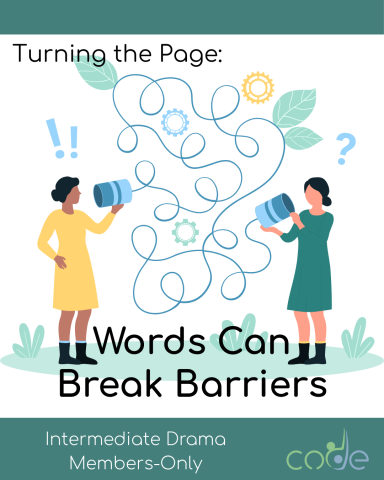
Words Can Break Barriers graphic
Two women with visibily distinct skin colours speak into a tin can connected by a long curling string, adorned with leaves and gears. One woman has two exclamation points above her head while the other woman has a question mark.
Unit Guiding Questions
  • What is the difference between Equality and Equity?
  • What is Power?
  • What is a Barrier?
  • Identify different types of barriers that exist in our school community.
  • Why is something a barrier for some people, but not for others?
  • How can we overcome barriers?
  • Whose responsibility is it to remove barriers for others?
  • How does Reading and Writing (Literacy) give us power?
  • How is not knowing how to read a barrier?
Readiness

This series of lessons and activities can be used at any point in the year, however, the teacher and students should have a strong rapport and willingness to engage in some challenging topics. Students should have prior experience exploring the elements of Drama (role/character; relationship; time and place; tension; focus and emphasis). Familiarity with the conventions of Tableau, Monologue, Scene Work, Choral Speaking, and Thought-Tracking would be an asset.

Assessment and Evaluation

Assessment for Learning

  • Observational Checklist
  • Review of student writing activities and Word Study
  • Peer Feedback (Two Glows and a Grow)

Assessment as Learning

  • Class discussions
  • Culminating Task Reflection

Assessment of Learning

  • Tableau rubric
  • Choral speaking rubric
  • Culminating Task Performance rubric
  • Observational Checklist
  • Reflection evaluation

Lessons

Lesson 1 - Equal, but not Fair

This lesson will introduce students to the notions of fairness and equality. Students will use drama games to begin to explore the concepts of equity and equality.

Lesson 2 - Equity vs Equality

During this lesson, students will begin to understand the differences between equity and equality. Students will expand on their knowledge of Tableau and how it can be used to explore challenging subjects. Students will complete another Word Study, then analyze an animated short using their new vocabulary. Finally, students will solidify their learning through a dramatic choral activity.

Lesson 3 - Words are Powerful

Throughout this lesson, the class will explore a famous game from Augusto Boal’s work with Theatre of the Oppressed. Students will also engage in another Word Study, this time exploring power and its various meanings. Students will then have the opportunity to create a series of tableau, accented with thought-tracking from the character’s personal perspectives.

Lesson 4 - Words Can Break Barriers

During this lesson, students further expand their vocabulary with a Word Study focused on barriers. Students will then complete some action research around their school environment, identifying barriers, and considering various causes and effects of barriered and barrier-free spaces. Finally, students will engage in improvised role-play, giving voice to inanimate objects and/concepts, as they attempt to identify and dismantle barriers in their lives.

Lesson 5 - Literacy in Action

This lesson requires students to gather information about Literacy, summarize their findings, and make personal connections. This information will later be used for the culminating task for this unit.

Lesson 6 - Words Can Break Barriers Performance

In the culminating task for the unit, students will solidify their understanding of the new concepts and vocabulary from the unit. Students will individually and collaboratively create a choral and movement performance piece which explores the power of words.

Subject / Panel: Drama / Intermediate
Terms: Unit Plans, critical literacy

Lessons / Leçons

Lesson / Leçon 1
Equal, but not Fair
Lesson / Leçon 2
Equity vs Equality
Lesson / Leçon 3
Words are Powerful
Lesson / Leçon 4
Words Can Break Barriers
Lesson / Leçon 5
Literacy in Action
Lesson / Leçon 6
Words Can Break Barriers Performance

Appendices / Annexes

Appendix / Annexe 1
Curriculum Expectations
Appendix / Annexe 2
Culminating Task Overview
Appendix / Annexe 3
Reflection Prompts

Printable materials / Matériel imprimable

  • PDF icon PDF #1 Word Study 1
  • PDF icon PDF #2 Word Study 2
  • PDF icon PDF #3 Ian Mind Map
  • PDF icon PDF #4 Word Study 3
  • PDF icon PDF #5 Word Study 4
  • PDF icon PDF #6 Field Study Notes
  • PDF icon PDF #7 Literacy in Action
  • PDF icon PDF #8 Individual Writing Template
  • PDF icon PDF #9 Group Writing Template
  • PDF icon PDF #10 Culminating Task Rubric
  • PDF icon PDF #11 Reflection Evaluation
  • PDF icon PDF #12 Observational Checklist
Feedback
  • Privacy Policy
  • Terms of Use
  • Search
  • FAQ
  • Contact

© CODE The Council of Ontario Drama and Dance Educators. Charitable Registration Number: 119228807RR0001