Abstract:
This is an example of one Site-Specific Theatre Project, using Indigenous material as a provocation to create. It was a unit in a senior drama class that was a combined ADC3M and 4M - Drama in the Community.

This resource was generously donated by Matthew Sheahan.
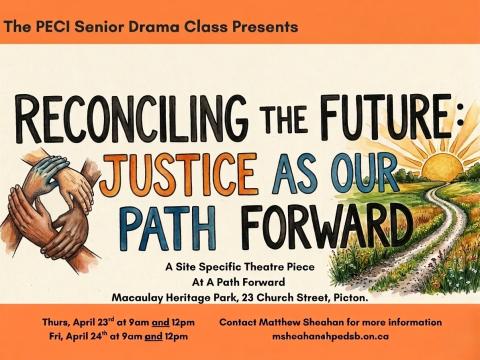
Reconciling the Future - Justice as a Our Path Forward was a site specific theatre project that took place in Picton, Ontario in April 2026. It was co-created by the Indigenous Education Department (as part of Innovation and Inclusion Services at Hastings and Prince Edward District School Board), Prince Edward Collegiate Institute (PECI), and “A Path Forward,” an art exhibit co-curated by Tsi Tyónnheht Onkwawén:na (the language and cultural centre on Tyendinaga Mohawk Territory) and the municipality of Prince Edward County.
Members of the ADC3M/4M senior Drama in the Community course at Prince Edward Collegiate Institute (PECI) participated in a project that included devising using the visual art work (paintings, sculptures, photography, regalia, etc.) as sources.
This devised, collective creation, was informed by the concepts found in CODE's In a Good Way document, and was an example of how we can infuse and elevate Indigenous voices and perspectives free from appropriation, even in performance.
The entire performance day schedule consisted of the following:
Explore the project and view the documentary on the process and the performance.
This resource is meant to be an exemplar for creating by using Indigenous art (or other provocations), regardless of the background and cultural grounding of the students in the classroom. This is not a step-by-step blueprint, but meant to be an inspiration for similar projects exploring Indigenous content and fostering the conversation around reconciliation and a path forward together, free from appropriation of voice and/or culture.
We had access to a museum in walking distance from the school. The majority of people might not have this type of access. Think about where you could perform and what you could do to create in the same (e.g., outside in a courtyard, in a library, etc). The process itself is as important as the where and what.
The students who participated in the project were all senior drama students. The ADC3M and 4M Drama in the Community courses prerequisites are ADA1O and/or ADA2O for 3M, and the 3M to gain entry into the 4M. The students have all created and collaborated with students in previous drama courses.
The discussions that were had with all participants was that we were going to create this pieces as a site specific class project to be performed for four public audiences, and we were also creating an exemplar for other drama teachers and students to elevate and infuse Indigenous voices and perspectives free from appropriation of voice or culture.
Setting the Stage
This lesson was a pre-learning and pre-art exploration lesson, focusing on activating prior knowledge, fostering discussion and creating the raw materials for the opening scene for the devised final piece.
The end result of this lesson will be the construction of material for a choral opening, followed by constructing tableaux as an entire class encapsulating the key terms that we all agree upon when we think of “Reconciliation” and “Justice.”
75 minutes
Raw Materials (On-site)
The second day focused on the beginning of the creation of the first group piece exploring the art work A Path Forward and providing the building blocks to work through the entire Devising process. (Because of travel time, the lesson was about 50 minutes).
50 minutes
Raw Materials Continued (On-site)
This lesson is a continuation of the creation in the space for the Site Specific Theatre piece. It was the second full visit to the space and time spent creating in the space. (Because of travel time, the lesson was about 50 minutes).
50 minutes
Creating, Rehearsing and Refining
This “lesson” is a combination of all rehearsal and preparation days leading to the final performance in the site for Reconciling the Future. See PDF 5 - Example Monthly Project Schedule.
12-15 periods
(1 period = ~75 minutes)
Site-Specific Theatre and Consolidation
Two full days of performances on site at A Path Forward, followed by the Consolidation Activity on day three.
3 periods
