
The second day focused on the beginning of the creation of the first group piece exploring the art work A Path Forward and providing the building blocks to work through the entire Devising process. Lesson 2 & 3 took place at the museum and the students created based on their reactions and reflections to the art. The period was shorter because of needed travel time. (Approximately 50 minutes)
Learning Goals
- Gain a deeper understanding of Site-Specific Theatre
- Understand the devising process
- Interpret and reflect on visual art and be able to articulate those feelings to a group of peers
- Gain a deeper understanding and appreciation for chosen pieces of art in the space
- Deepen their understanding of Choral Speaking and the use of voice
Terminology
- Flow Writing
- Choral Speaking
- Devising and Devised Theatre
- Letter Mash Up
Materials
- The Museum and the artwork being used
- Paper, pencil (writing utensil) or computer/assistive technology
- Chart paper and markers
Minds On
Whole Class > Opening Circle & Tour
Gather in a circle in the middle of the museum. Discuss and reference the assignment sheet. Remind them of what Site-Specific Theatre is and that we are going to be performing the final product at the museum.
Give the students 10 minutes to explore the entire space and engage with the art.
Students are asked to return to the circle with one of the following to share:
- What was your favourite piece? Why?
- Develop one question you have regarding the space
- What interests you about the space? Explain.
Debrief discussion in a Talking Circle.
Teacher Tip: Allow students to pass and have the right to share later if a thought occurs to them after the fact.
Action
Individual/Small Groups > Flow Writing
Group students according to the number of paintings/artifacts being explored. Distribute PDF #2 to each group. Using these prompts, students will write "Letters that they'll never send" to each artwork. Give students 5 minutes at each artwork and encourage them to focus on one prompt at a time.
Teacher Note: They write their piece individually, but the group they are travelling with is the group they will be creating this first scene with after working through the process.
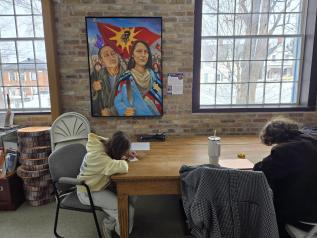
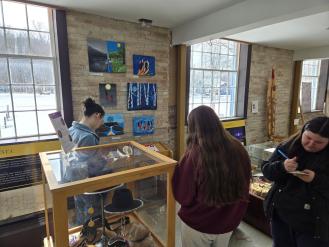
Small Groups > Sharing & Letter Mash Up
- Have each member of the group share what they wrote
- Read over each letter again and find lines from each poem that could be used together
- Perform a Letter Mash Up with the group, combing all four/five letters together into one piece that can be chorally interpreted
- Begin chorally interpreting the Letter Mash Up; refer to CODE's Choral Speaking resource for suggestions/support for this activity.
Teacher Note
- Movement and music will be added to the choral interpretation.
- A second 75-minute period can be allotted for the “Letter Mash Up” portion of the lesson in the classroom
Consolidation
Whole Class > Talking Circle
Gather the class together in a circle.
Key Questions for Discussion
- What stood out to you in the museum?
- What is one of the greatest barriers in creating this piece?
- Why site-specific? Why are we doing this here? What’s the point?
Differentiation (DI)
- If students cannot get to the space for physical reasons, bring images of the artwork to them at the school.
- Provide the opportunity to use speech to text or computers if writing is an issue.
Assessment as Learning (AaL)
- Teacher observations of the creative process
- The Letter Mash Up
Assessment for Learning (AfL)
- Individual letters
- The Letter Mash Up
- Teacher observations of the students participating in the process
